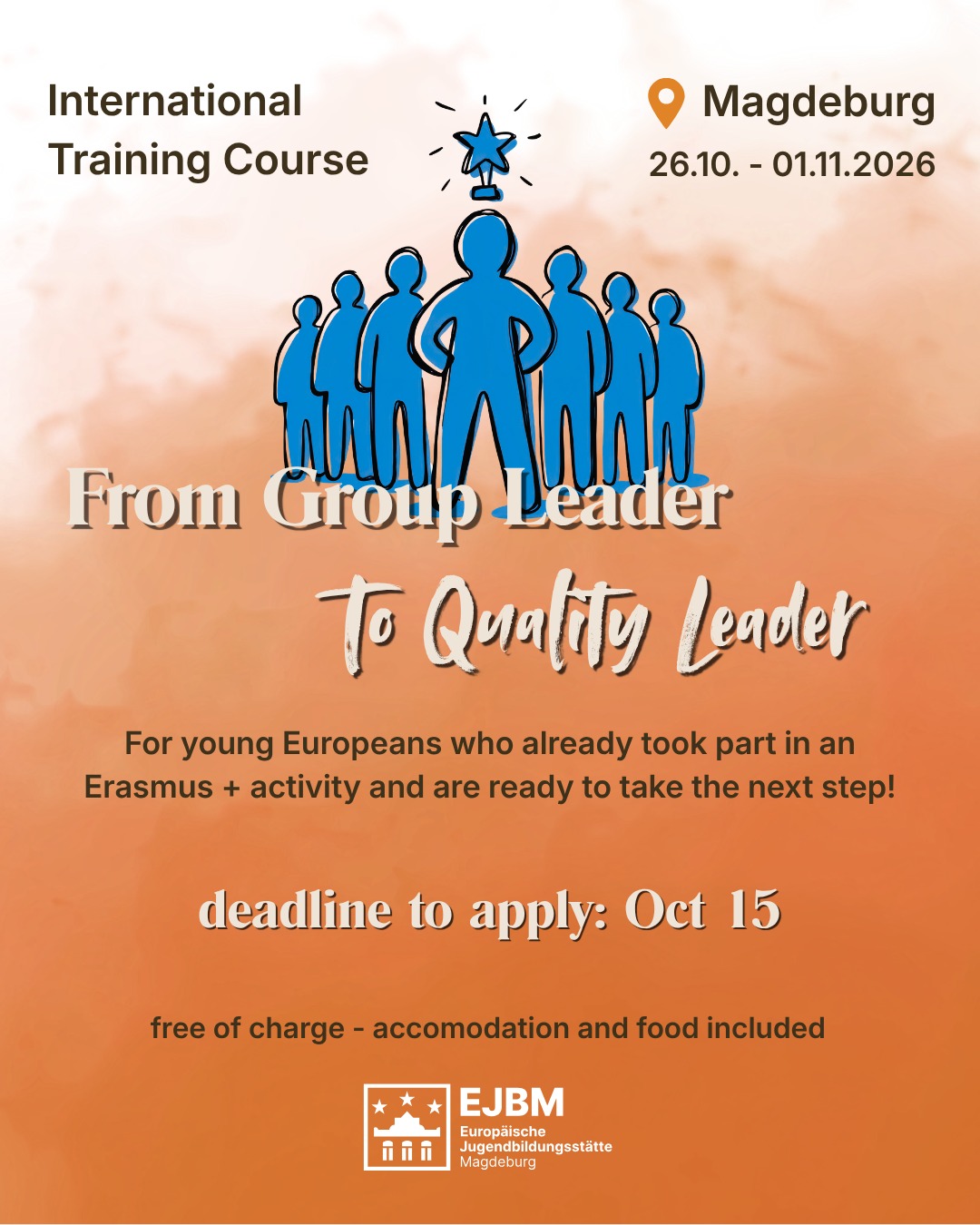
Have you already taken part in an Erasmus+ activity and would now like to take on more responsibility? In the five-day training course “From Group Leader to Quality Leader”, you will develop practical skills for supporting international youth exchanges. Through simulations, case studies, team activities and hands-on facilitation practice, you will explore group dynamics, inclusion, conflict management, safeguarding and Youthpass. You will receive feedback, discover new perspectives and gain practical tools for your next projects.
Participation in an international training course at the European Youth Education Centre (EJBM) is free of charge. Accommodation in shared rooms and full board are included.
A successful international youth exchange needs group leaders who can support young people, create inclusive group processes, facilitate learning and respond confidently to challenging situations. This training course provides practical knowledge about the roles, responsibilities and boundaries of group leaders, communication, group dynamics, participation, inclusion, diversity and gender equality.
Further topics include working with young people aged 13–17, supporting different emotional and mental health-related needs, conflict management, safeguarding and Youthpass. You will also explore how group leaders can contribute to the quality of a youth exchange before, during and after the project.
The course uses non-formal education, experiential learning, simulations, case studies, team activities, reflection methods and peer learning. During the Micro-Facilitator Challenge, you will facilitate activities yourself, try out new methods and receive direct feedback. A learning experience in Magdeburg complements the programme.
The training course is open to professionals aged 18 and over who have already taken part in an Erasmus+ activity. Previous group leader experience is welcome but not required. The course is suitable both for people preparing for their first experience as a group leader and for experienced group leaders who want to strengthen their skills and gain new perspectives.
You should be willing to participate actively, try out practical methods and communicate in English throughout the course.
| Monday 26 October |
Arrival; getting to know each other and team-building in the evening |
| Tuesday 27 October |
Morning Welcome, presentation of EJBM and house rules Getting to know each other, Erasmus+ journeys and expectations Afternoon Actionbound at EJBM The role, responsibilities and boundaries of a group leader; leadership styles, Group Leader Suitcase and Leadership Line Reflection Evening Intercultural evening |
| Wednesday 28 October |
Morning Group dynamics, communication and active listening Afternoon Inclusion, diversity and gender equality; participation, stereotypes and psychological safety Reflection Evening Games evening |
| Thursday 29 October |
Morning Non-formal learning and facilitation with the Marshmallow Challenge, reflection tools and the Micro-Facilitator Challenge Afternoon Trip to Magdeburg city centre, city exploration with Actionbound and free time Evening Reflection Café about the day’s experiences and learning outcomes |
| Friday 30 October |
Morning Conflict management, challenging situations and safeguarding with a crisis simulation Afternoon Working with young people aged 13–17 and supporting different needs; inclusion, mental health-related needs and professional boundaries Reflection Evening Case Night: real stories and shared solutions |
| Saturday 31 October |
Morning Youth exchange quality before, during and after the project; participant preparation, learning, Youthpass and dissemination Afternoon Personal development and multiplier plan with a competence map and 30–60–90-day plan Closing, evaluation and certificates Evening Silent Disco |
| Sunday 1 November |
Departure |
Travel expenses will be reimbursed based on Erasmus+ rules, up to a certain limit.
The Erasmus+ Programme Guide for 2024 has updated the reimbursement rates for travel costs based on distance, and the new values are as follows:
| Distance | Green Travel (€) / person | Non-Green Travel (€) / person |
|---|---|---|
| 10–99 km: | €56 | €28 |
| 100–499 km: | €285 | €211 |
| 500–1,999 km: | €417 | €309 |
| 2,000–2,999 km: | €535 | €395 |
| 3,000–3,999 km: | €785 | €580 |
| 4,000–7,999 km: | €1,188 (both green and non-green travel) | |
| 8,000 km or more: | €1,735 (both green and non-green travel) | |
You can get an estimate of the distance that applies to you with the Erasmus+ Distance Calculator.
Green Travel: Travel that use low-emissions means of transport for the main part of the travel, such as bus, train, bike or car-pooling. Please check the Eramus+ Programme Guide for further information.
Please apply via e-mail to Anne:

International training courses in the international educational and youth work field offer diverse opportunities for educators, youth workers and volunteers to enhance their skills and knowledge on a global scale. These courses typically cover pedagogical techniques, curriculum development, and educational technology, fostering a cross-cultural perspective.
Participants engage in collaborative learning, gaining insights into varied teaching methodologies, youth engagement strategies, and cultural nuances. Ultimately, these programs equip educators and youth workers with the tools to create more inclusive and effective learning environments and youth development initiatives.
The EJBM regularly offers various international training courses in Magdeburg with different topics and learning objectives.
EJBM training courses are primarily aimed at professionals who are currently actively involved in youth work. Volunteers in the field are also invited to attend. If there are more applications than places available, a pre-selection procedure will take place.

Im Trainingskurs beschäftigst du dich mit dem gesamten Ablauf eines deutsch-französischen Jugendprojekts: von der ersten Idee über die Antragstellung und Durchführung bis zum Verwendungsnachweis. Du lernst die Förderlogik, Programme, Kriterien und Prioritäten des Deutsch-Französischen Jugendwerks kennen und erhältst außerdem einen Einblick in Erasmus+ sowie den Deutsch-Französischen Bürgerfonds.
In deutsch-französischen Arbeitsgruppen entwickelst du eine tragfähige Projektidee. Dabei setzt du dich mit Zielgruppen, Zielen, Partnersuche, Zusammenarbeit, Programmplanung, Finanzierung und Kofinanzierung auseinander. Schritt für Schritt entsteht ein vollständiger DFJW-Förderantrag. Präsentation, Auswertung und Überlegungen zur tatsächlichen Umsetzung runden die gemeinsame Arbeit ab.
Besuche verschiedener Institutionen, Programmpunkte im Rahmen der französischen Filmwoche und ein Netzwerkdinner schaffen zusätzliche Gelegenheiten für fachlichen und deutsch-französischen Austausch.
Der Trainingskurs richtet sich an volljährige Fachkräfte der Kinder- und Jugendhilfe, Projektverantwortliche, Multiplikator*innen der internationalen Jugendarbeit sowie Freiwillige in passenden Einsatzbereichen. Interessierte aus Sachsen-Anhalt werden bevorzugt berücksichtigt.
Du benötigst weder Vorerfahrung mit Förderanträgen noch besondere Sprachkenntnisse. Entscheidend sind dein Interesse an deutsch-französischen Jugendprojekten und deine Bereitschaft, eigene Ideen einzubringen und gemeinsam weiterzuentwickeln.
|
Mittwoch 18. November |
Anreise, Begrüßung, Kennenlernen und Austausch über Erwartungen an den Trainingskurs |
|
Donnerstag 19. November |
Grundlagen deutsch-französischer Jugendprojekte, Einführung in die Zusammenarbeit und Überblick über Programme, Förderlogik und Kriterien des DFJW |
|
Freitag 20. November |
Von der Projektidee zum Antrag: Antragsformulare, Praxisbeispiele, Zielgruppen, Projektziele, Partnersuche sowie Programm- und Finanzplanung |
|
Samstag 21. November |
Antragstellung und Abrechnung im Detail, Arbeit am eigenen DFJW-Förderantrag und Einblick in weitere Fördermöglichkeiten |
|
Sonntag 22. November |
Fertigstellung und Präsentation der Projektideen, gemeinsame Auswertung und Entwicklung von Perspektiven für eine praktische Umsetzung |
|
Montag 23. November |
Abreise |

International training courses in the international educational and youth work field offer diverse opportunities for educators, youth workers and volunteers to enhance their skills and knowledge on a global scale. These courses typically cover pedagogical techniques, curriculum development, and educational technology, fostering a cross-cultural perspective.
Participants engage in collaborative learning, gaining insights into varied teaching methodologies, youth engagement strategies, and cultural nuances. Ultimately, these programs equip educators and youth workers with the tools to create more inclusive and effective learning environments and youth development initiatives.
The EJBM regularly offers various international training courses in Magdeburg with different topics and learning objectives.
EJBM training courses are primarily aimed at professionals who are currently actively involved in youth work. Volunteers in the field are also invited to attend. If there are more applications than places available, a pre-selection procedure will take place.
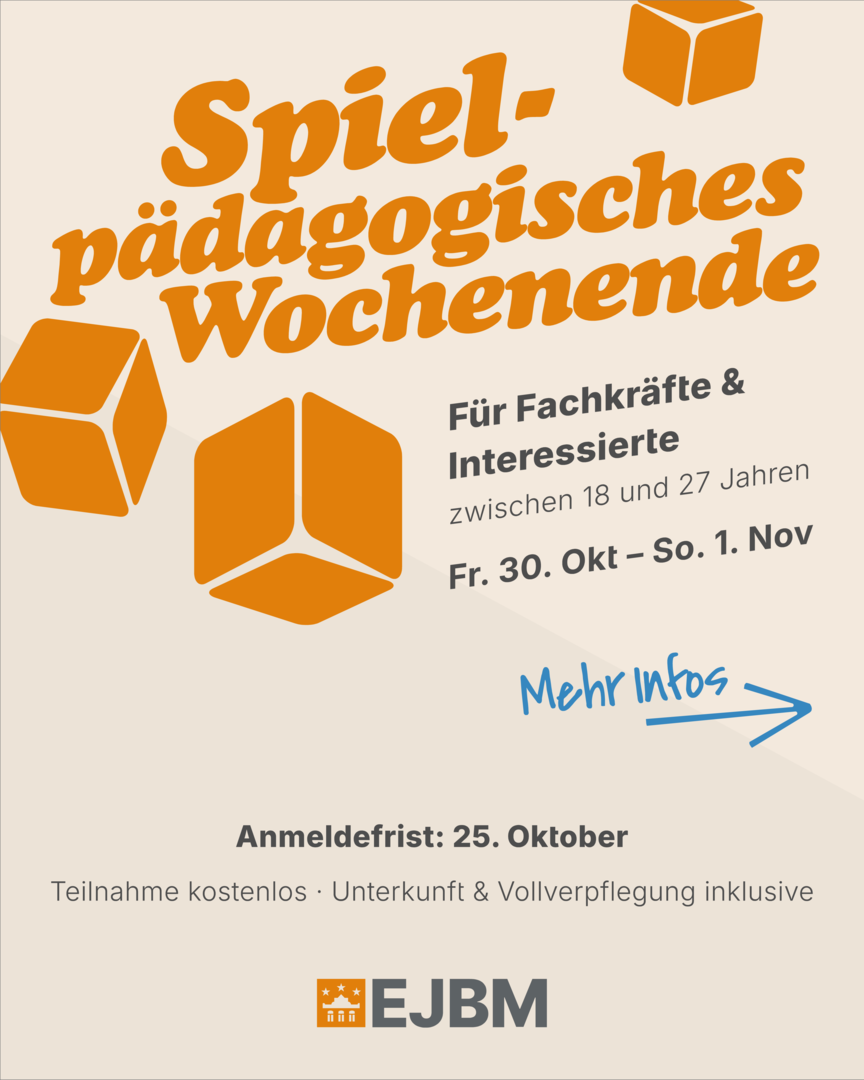
Entdecke, wie viel pädagogisches Potenzial in Spielen steckt! Beim spielpädagogischen Wochenende lernst du Grundlagen der Spielpädagogik und Gamification kennen, analysierst bekannte Spiele und entwickelst gemeinsam mit anderen eigene Ideen für die Jugendarbeit. Kurze fachliche Impulse wechseln sich mit praktischem Ausprobieren, kreativem Austausch und gemeinsamen Spieleabenden ab. Vorerfahrungen oder bestimmte Englischkenntnisse brauchst du nicht; Neugier und Freude am Spielen genügen.
Im Mittelpunkt des Seminars stehen die Grundlagen von Spielpädagogik und Gamification sowie die Frage, wie spielerische Ansätze in der europäischen Jugendarbeit eingesetzt werden können. Gemeinsam analysieren wir verschiedene Spiele, lernen bestehende Methoden und Planspiele kennen und entwickeln bzw. passen in Gruppen eigene Spiele an.
Das Seminar ist für alle, die gerne „out of the box“ denken, kreativ werden möchten und sich mit spielerischen Ansätzen in der Arbeit mit jungen Menschen auseinandersetzen wollen.
Das Wochenende verbindet kurze fachliche Impulse mit praktischer Erprobung, Austausch und gemeinsamen Spieleabenden. Auch wenn du noch keine Erfahrung hast, bist du herzlich eingeladen. Gemeinsam entdecken wir die vielfältige Welt der Spiele – sei es Werwolf, Monopoly oder ein einfaches Kartenspiel. Komm vorbei und schau selbst, wie viel Potenzial in Spielen stecken kann!
Teilnehmen können junge Menschen und Fachkräfte im Alter von 18 bis 27 Jahren, die ihren Wohnsitz in Sachsen-Anhalt haben und sich für Spielpädagogik, Gamification und kreative Methoden in der Jugendarbeit interessieren. Vorerfahrungen sind nicht erforderlich.
Das Programm findet auf Deutsch und Englisch statt. Englischsprachige Inhalte werden bei Bedarf übersetzt. Wichtig sind vor allem deine Neugier, Offenheit und Freude am gemeinsamen Ausprobieren und Entwickeln von Spielen.
|
Freitag 30. Oktober |
Anreise ab 14:30 Uhr Nachmittag Begrüßung und Kennenlernen Einführung in Spielpädagogik und Gamification Abend Spieleabend |
|
Samstag 31. Oktober |
Vormittag Analyse des Spieleabends und der eingesetzten Spielmechanismen Grundlagen der Spielpädagogik, Selbstbestimmungstheorie und Gamification Nachmittag Vorstellung von Planspielen und weiteren erprobten Methoden Gruppenarbeit – Spiele entwerfen oder anpassen Abend Gemeinsames Abendprogramm |
|
Sonntag 1. November |
Vormittag Präsentation der Gruppenarbeitsergebnisse und Feedback Weitere spielpädagogische Ansätze und ihr Einsatz in der europäischen Jugendarbeit Nachmittag Auswertung und Abschied Abreise ab 14:30 Uhr |
International training courses in the international educational and youth work field offer diverse opportunities for educators, youth workers and volunteers to enhance their skills and knowledge on a global scale. These courses typically cover pedagogical techniques, curriculum development, and educational technology, fostering a cross-cultural perspective.
Participants engage in collaborative learning, gaining insights into varied teaching methodologies, youth engagement strategies, and cultural nuances. Ultimately, these programs equip educators and youth workers with the tools to create more inclusive and effective learning environments and youth development initiatives.
The EJBM regularly offers various international training courses in Magdeburg with different topics and learning objectives.
EJBM training courses are primarily aimed at professionals who are currently actively involved in youth work. Volunteers in the field are also invited to attend. If there are more applications than places available, a pre-selection procedure will take place.
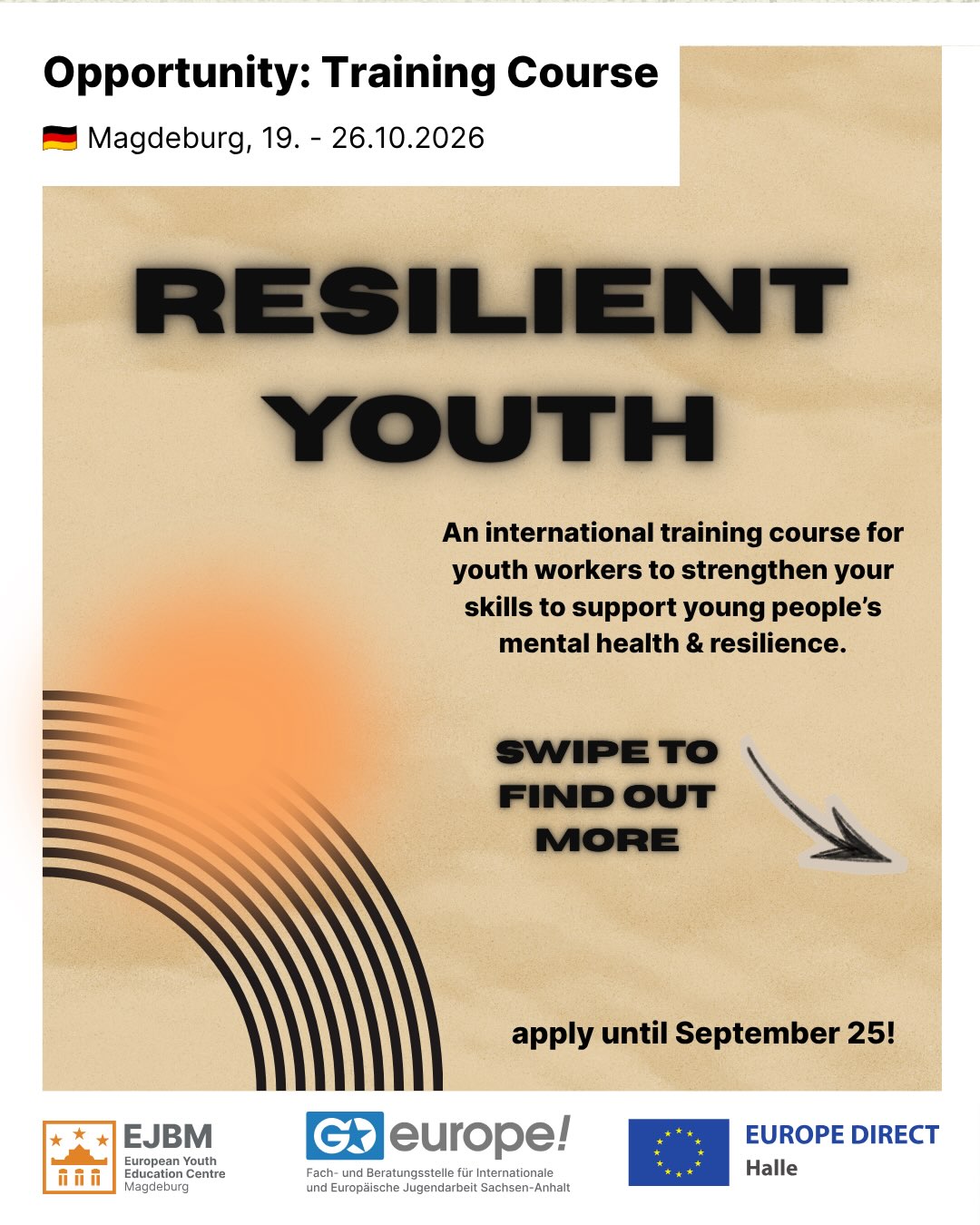
The course focuses on resilience, mental health and wellbeing in everyday youth work. Participants will learn how to listen actively, ask supportive questions, recognise stress and emotional overload, create psychologically safe spaces and maintain appropriate professional boundaries.
The programme combines discussion, peer learning, reflection, role-play, case work and practical activity development. Participants will design and test their own methods and jointly create a Resilient Youth Work Toolkit that they can use in their organisations.
| Monday 19 October |
Arrival, accommodation, introduction to the training course and getting to know each other Evening Welcome dinner |
| Tuesday 20 October |
Morning Understanding resilience, mental health and wellbeing Afternoon The Hand of Mental Health; exploring what makes young people resilient; reflection |
| Wednesday 21 October |
Morning Active listening and listening without immediately trying to solve problems Afternoon Supportive dialogue, open questions and practical role-play |
| Thursday 22 October |
Morning Recognising stress, emotions and overload; “Mental Salad” activity Afternoon Exploring Magdeburg Evening Intercultural sharing |
| Friday 23 October |
Morning Supporting young people without becoming a therapist; boundaries, responsibility and referral Afternoon Psychological safety, inclusive youth work and the Resilience Lab case challenge |
| Saturday 24 October |
Morning What builds resilience in youth work? Activity design laboratory Afternoon Developing resilience and mental-health activities and testing them with other groups |
| Sunday 25 October |
Morning Creating the Resilient Youth Work Toolkit and planning practical transfer Afternoon Evaluation, Youthpass and preparation for departure Evening Final celebration |
| Monday 26 October |
Departure of participants |
Travel expenses will be reimbursed based on Erasmus+ rules, up to a certain limit.
The Erasmus+ Programme Guide for 2024 has updated the reimbursement rates for travel costs based on distance, and the new values are as follows:
| Distance | Green Travel (€) / person | Non-Green Travel (€) / person |
|---|---|---|
| 10–99 km: | €56 | €28 |
| 100–499 km: | €285 | €211 |
| 500–1,999 km: | €417 | €309 |
| 2,000–2,999 km: | €535 | €395 |
| 3,000–3,999 km: | €785 | €580 |
| 4,000–7,999 km: | €1,188 (both green and non-green travel) | |
| 8,000 km or more: | €1,735 (both green and non-green travel) | |
You can get an estimate of the distance that applies to you with the Erasmus+ Distance Calculator.
Green Travel: Travel that use low-emissions means of transport for the main part of the travel, such as bus, train, bike or car-pooling. Please check the Eramus+ Programme Guide for further information.
International training courses in the international educational and youth work field offer diverse opportunities for educators, youth workers and volunteers to enhance their skills and knowledge on a global scale. These courses typically cover pedagogical techniques, curriculum development, and educational technology, fostering a cross-cultural perspective.
Participants engage in collaborative learning, gaining insights into varied teaching methodologies, youth engagement strategies, and cultural nuances. Ultimately, these programs equip educators and youth workers with the tools to create more inclusive and effective learning environments and youth development initiatives.
The EJBM regularly offers various international training courses in Magdeburg with different topics and learning objectives.
EJBM training courses are primarily aimed at professionals who are currently actively involved in youth work. Volunteers in the field are also invited to attend. If there are more applications than places available, a pre-selection procedure will take place.
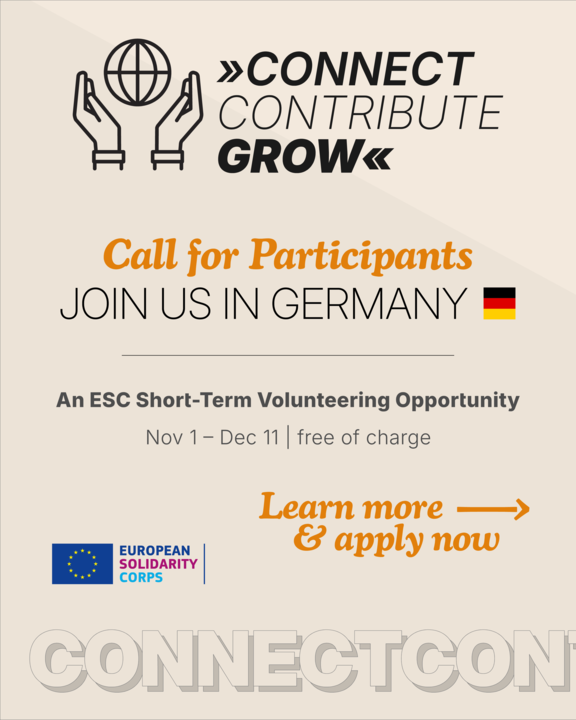
Join an ESC team of up to 15 international volunteers and become part of the everyday life of the European Youth Education Centre Magdeburg (EJBM). This project gives you the opportunity to explore different areas of our work and gain practical experience through a variety of tasks.
During your stay at EJBM, you will have the opportunity to support different areas of our youth centre and become an active part of its everyday life. Your tasks will be varied and will combine practical, organisational and educational activities. With guidance from our staff, you may help prepare meals, support the service team, assist with small repairs and maintenance, or take part in minor construction and hands-on tasks around the centre.
At the same time, you will contribute to the educational and social activities taking place at EJBM. This may include helping with our annual Christmas market, providing language animations and activities for groups of children visiting the youth centre, and supporting programmes and events during your stay in Magdeburg.
The project is about versatility, learning by doing and bringing different elements of our work together. It offers you the chance to gain hands-on experience, develop practical life and workplace skills, discover your strengths and become more confident in taking responsibility and working as part of a team.
Travel expenses will be reimbursed based on Erasmus+ rules, up to a certain limit.
The Erasmus+ Programme Guide for 2024 has updated the reimbursement rates for travel costs based on distance, and the new values are as follows:
| Distance | Green Travel (€) / person | Non-Green Travel (€) / person |
|---|---|---|
| 10–99 km: | €56 | €28 |
| 100–499 km: | €285 | €211 |
| 500–1,999 km: | €417 | €309 |
| 2,000–2,999 km: | €535 | €395 |
| 3,000–3,999 km: | €785 | €580 |
| 4,000–7,999 km: | €1,188 (both green and non-green travel) | |
| 8,000 km or more: | €1,735 (both green and non-green travel) | |
You can get an estimate of the distance that applies to you with the Erasmus+ Distance Calculator.
Green Travel: Travel that use low-emissions means of transport for the main part of the travel, such as bus, train, bike or car-pooling. Please check the Eramus+ Programme Guide for further information.
The European Solidarity Corps (ESC) is an amazing opportunity for young people who want to travel abroad and make a positive impact on communities and society. It's a program run by the European Union that gives young people between the ages of 18 and 30 the chance to volunteer or work on projects that make a real difference in the world.
Whether you want to help others, learn new skills or gain valuable experience, our ESC projects have something for everyone. With a wide range of projects available, you can choose to work on something that matches your passions and interests. From helping the elderly and disabled to protecting the environment and promoting cultural diversity, the possibilities are endless.
Not only will you make a meaningful contribution to society, but you'll also develop new skills, make new friends and broaden your horizons. You'll have the opportunity to learn from other cultures, build your network, and gain experiences that will last a lifetime.
So if you're looking for a way to make a positive impact, grow as a person, and have the time of your life, an ESC project at EJBM is the perfect opportunity for you! Apply now and start your journey towards a more fulfilling and meaningful future.
ESC Official Website ESC Official FAQThe button below will take you to this volunteering opportunity on the European Youth Portal. We can only consider applications that you submit there.

Europäische Jugendbildungsstätte Magdeburg
bei der Bildungsnetzwerk Magdeburg gGmbH
Lüttgen-Ottersleben 18a
39116 Magdeburg


